
Introduction: The 7p’s of marketing
Want a simple framework to grow your business without guessing? The 7p’s of marketing give you a proven checklist to build offers customers love. In this friendly guide, you’ll learn each “P,” see real-world examples, and get clear actions you can apply today—whether you run an online store, a local cafe, or a service business. Read on to turn marketing theory into practical wins.
Why the 7p’s of marketing matter
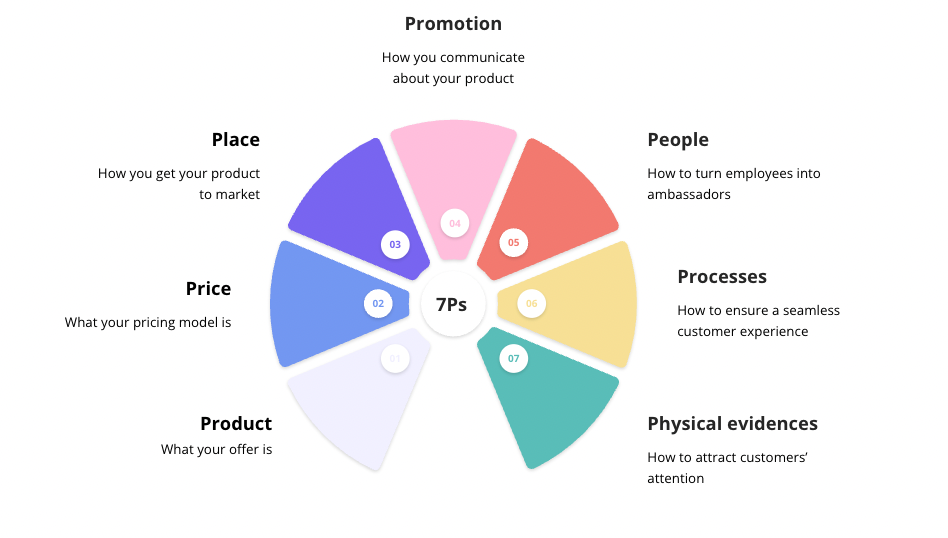 The original 4Ps (Product, Price, Place, Promotion) explain classic marketing. Adding People, Process, and Physical Evidence makes the model modern and customer-focused. Use the 7p’s of marketing to align every part of your business so customers get value consistently—this drives trust, referrals, and repeat sales.
Explaining The 7p’s of marketing:
1. Product: Deliver real value
 What it is
Product means the goods or services you sell, features, benefits, and how it solves a customer problem.
Practical tips
Define the core benefit first (what problem you solve).
Differentiate with features, packaging, warranty, or guarantees.
Iterate based on feedback—use surveys and reviews.
Example
A local bakery sells “gluten-free celebration cakes.” The core benefit is safe, delicious celebration desserts. They add branded boxes and a satisfaction guarantee—making the product more valuable and shareable.
2. Price: Smart pricing wins customers
 What it is
Price is not just a number; it signals value, positioning, and profit margins.
Practical tips
Test prices with small audiences.
Use tiered pricing: Basic, Standard, Premium.
Offer limited-time discounts or bundled pricing to increase conversions.
Example
A SaaS app offers a free trial, a low-cost monthly plan for casual users, and a premium plan with priority support. The tiered approach captures beginners and power users.
3. Place: Make it easy to buy
 What it is
Place refers to where and how customers access your product—online store, physical shop, marketplaces, or distributors.
Practical tips
Choose channels your audience prefers (Instagram vs Amazon).
Optimize checkout for mobile.
Use local SEO and Google Business Profile for local customers.
Example
A handmade-skincare brand sells on its WordPress store, Etsy, and local farmer’s markets. Each platform attracts different buyers and increases overall reach.
4. Promotion: Communicate compellingly
 What it is
Promotion covers advertising, content, social media, PR, and sales tactics to attract and convert customers.
Practical tips
Use content marketing to teach and build trust.
Retarget visitors with ads and email sequences.
Track ROI for each channel.
Example
A tutoring service posts short lesson videos on YouTube, runs Facebook lead ads, and sends email sequences. The mix builds credibility and converts trial students to paid packages.
5. People: Your team and customers
 What it is
People includes your staff, sales team, and customer interactions—anyone involved in delivering the experience.
Practical tips
Train frontline staff on empathy and product knowledge.
Create customer personas to align messaging.
Use customer service scripts with personalization.
Example
A boutique hotel trains staff to recognize VIP guests and capture preferences. Personalized service leads to glowing reviews and repeat bookings.
6. Process: Systems that deliver consistently
 What it is
Process means the steps customers pass through—from discovery to purchase to support. Well-designed processes reduce friction.
Practical tips
Map the customer journey and remove unnecessary steps.
Automate repetitive tasks (invoicing, onboarding emails).
Monitor KPIs like delivery time, response time, and churn.
Example
An online course platform automates enrollment, onboarding emails, and certificate issuance. Students get instant access and clear next steps, improving completion rates.
7. Physical Evidence: Proof that builds trust
What it is
Physical Evidence is tangible proof of quality: packaging, receipts, reviews, demos, website design, or store ambiance.
Practical tips
Showcase customer reviews and case studies.
Use professional photos and consistent branding.
Offer free samples or trial versions.
Example
A cleaning service shares before-and-after photos, video testimonials, and a professionally designed estimate sheet. These props reduce doubts and increase bookings.
How businesses use the 7p’s of marketing successfully
Local cafe: Improves “Place” by adding online ordering, strengthens “Promotion” with Instagram reels, trains baristas (People), and redesigns packaging (Physical Evidence) to boost takeout sales.
E-commerce brand: Tests price tiers (Price), adds faster shipping (Process), highlights user reviews (Physical Evidence), and expands into a new marketplace (Place).
Freelance consultant: Packages services as a productized offering (Product), sets clear proposals and onboarding (Process), and showcases client testimonials (Physical Evidence) to close higher-value contracts.
Actionable checklist to implement today
Product: Write one-sentence benefit statement for your main offer.
Price: Create two price tiers and a short-term promotional test.
Place: Identify one new sales channel to test this month.
Promotion: Plan three content pieces that teach and sell.
People: Train or brief staff on one customer pain point and response.
Process: Map your customer journey and remove one friction point.
Physical Evidence: Add or update three testimonials on your site.
7p’s of marketing — Long-term growth strategies
For sustainable growth, integrate the 7p’s of marketing into your quarterly planning. Use insights from monthly metrics to adjust one P per quarter—rotate focus so Product enhancements may follow a Promotion push, then a Process optimization.
Build a simple dashboard that shows one KPI per P (example: Product — return rate; Price — average order value; Place — channel conversion), and review it with your team to align priorities. This disciplined cadence prevents scattered changes and compounds improvements across the customer journey.
7p’s of marketing — Common pitfalls and fixes
Many businesses try to change everything at once; the smarter approach is targeted experiments tied to the 7p’s of marketing. Avoid these common mistakes: neglecting customer feedback (fix: schedule weekly review of reviews), over-discounting to chase sales (fix: test strategic bundles instead), and poor handoffs between teams that ruin experience (fix: document handoff steps in your Process). Small, measured fixes focused on one P at a time reduce risk and deliver clearer learning you can scale.
FAQ’s
Q: Do I need all 7P’s to succeed?
A: You don’t need perfection in every P, but checking each one helps you spot weak spots and prioritize improvements.
Q: Which P should I start with?
A: Start with Product and Promotion—make sure your offer solves a clear problem and people know about it.
Q: How often should I review the 7P’s of marketing?
A: Quarterly reviews work well for most small businesses; review faster if you’re testing big changes.
Conclusion
Using the 7p’s of marketing turns strategy into measurable actions. Start by auditing each P, pick one quick win from the checklist, and test it for 30 days. Small, consistent improvements across the 7P’s lead to stronger brands, higher conversions, and happier customers.